
A founder sees a competitor announce an AI assistant. The next day, someone shares a video of a business supposedly running itself. By Friday, a simple question has turned into a worry: are we already too late?
That feeling can make a team buy software before it agrees on the problem. The subscription arrives. The old spreadsheets remain. Nobody knows who owns the new process. Now there is another place to check.
Popularity is a signal, not a plan
The 2026 Stanford AI Index reports organisational AI adoption at 88%. Earlier report snapshots showed 55% for 2023 and 78% for 2024. These are survey findings, not a count of every business or proof of successful deployment. 2026 AI Index · 2025 findings.
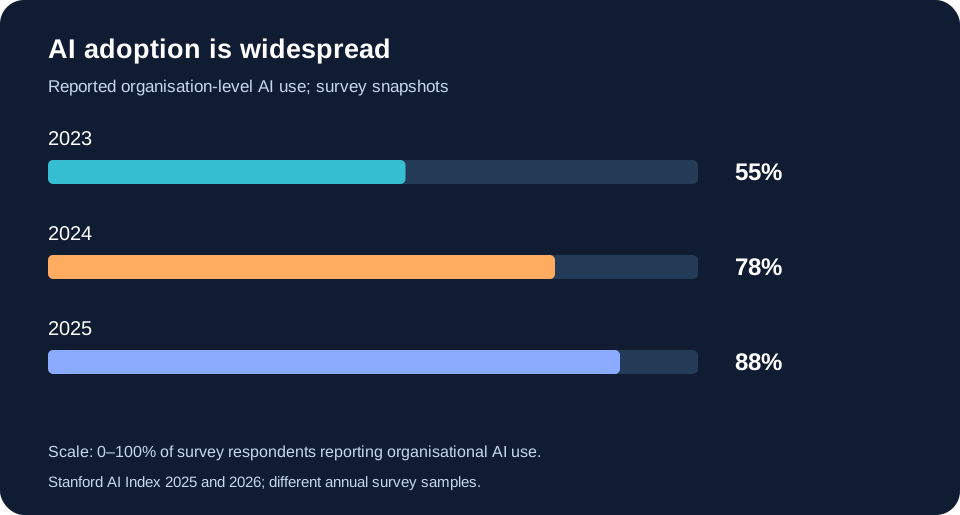
Read the chart values
| Measure | Value |
|---|---|
| 2023 | 55% |
| 2024 | 78% |
| 2025 | 88% |
The numbers give us a reason to pay attention. They do not tell a small customer-service team which task to change on Monday. A competitor using AI for product development may have very different needs from a company trying to keep its customer follow-up organised.
Find the cost of doing nothing
Instead of asking, “Which AI tool should we buy?”, ask where work repeatedly gets stuck. Pick an example from the last week:
- A promising enquiry sat without an owner.
- Someone copied the same information into three places.
- A customer had to repeat details after a handoff.
- A draft waited for approval because the reviewer missed the message.
Then look at frequency and consequence. Ten minutes spent on a rare task may be annoying but harmless. A missed handoff that loses a customer deserves more attention, even if it takes very little time.
Some problems need rules before AI
If the next step depends on an exact status, a straightforward rule may do the job. If a person must interpret a messy message or prepare a first draft, AI could help. If nobody has agreed what “ready” means, start by defining it.
Imagine a business receiving enquiries from a form. Before adding an assistant, it could create one working list, remove duplicates, assign an owner and record the next action. That simple structure also makes a later AI feature easier to evaluate.
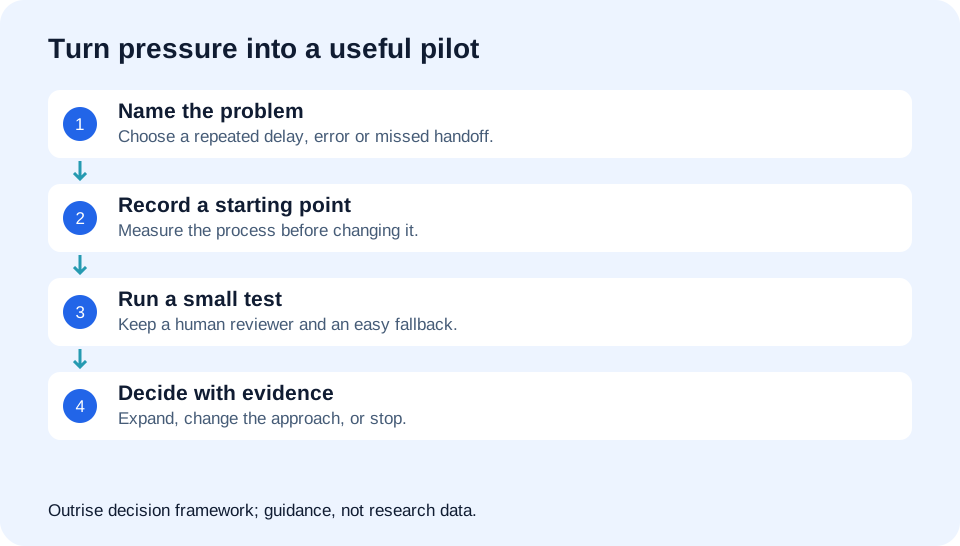
Read the workflow steps
- Name the problem: Choose a repeated delay, error or missed handoff.
- Record a starting point: Measure the process before changing it.
- Run a small test: Keep a human reviewer and an easy fallback.
- Decide with evidence: Expand, change the approach, or stop.
Give the test an honest finish line
Set a small scope and a review date. Record the time spent completing the task, checking the output and fixing errors. Ask the people doing the work whether the change actually helps them. A tool that produces more drafts but doubles checking time has not solved the problem.
A useful first win is specific: fewer missed handoffs, a clearer approval queue, or less repeated entry. Decide what improvement would justify the running cost before the pilot starts. Keep the old route available until the team can trust the new one.
There is nothing impressive about automating confusion. The businesses that benefit will be the ones that connect a tool to a clear need, give someone ownership and keep learning from real work.
ILLUSTRATIVE DISCUSSION
A question you might be asking.
These are example exchanges prepared by Outrise, not comments from visitors.
We want to try AI, but every department wants a different tool. What should come first?
Pick one repeated problem with a named owner. Agree what a useful improvement would look like, then test the complete process before expanding.
JOIN THE CONVERSATION
What does this look like in your business?
Share a practical question or experience. Comments are reviewed before they appear.